
You’ve built your website. You’ve added your services, uploaded your images, and made sure everything looks professional.
But when you check Google, the traffic is barely coming in.
You’re getting impressions but hardly any clicks. Your competitors seem to be everywhere, while your website is nowhere to be found. And you’re beginning to wonder whether having a website is even worth it.
Here’s the truth: having a website and getting found on Google are two different things.
If your website isn’t getting organic traffic, the solution isn’t necessarily to redesign it or publish dozens of blog posts. You first need to understand what’s preventing people from finding your pages, clicking on them, and taking action.
In this guide, we’ll walk through 11 practical reasons your website may not be getting traffic from Google, how to identify the problems, and what you can do to fix them.
1. Your Website Isn’t Indexed on Google
Before worrying about rankings, check whether Google has actually indexed your website pages.
Indexing means Google has processed a page and may be able to show it in search results. If an important page isn’t indexed, people generally won’t find it through ordinary Google searches.
How to check:
- Open Google.
- Search
site:yourwebsite.com, replacing the example with your actual domain. - Check whether your homepage and important service pages appear.
- Open Google Search Console and use the URL Inspection tool to check individual pages.
If a page isn’t indexed, check for issues such as a noindex directive, crawl restrictions, canonical tags pointing to another URL, or technical errors. You can request indexing after fixing the underlying problem, but Google doesn’t guarantee that every submitted page will be indexed.
What to do: Start with your homepage, key service pages, and important blog posts. Make sure they’re accessible to Google and linked appropriately within your website.
2. Your Website Is Ranking Too Low
Your website can appear in Google search results without attracting meaningful traffic.
For example, someone searching for a digital marketing agency in Nigeria may see results from several established agencies before reaching your website. If your page appears much further down the results, fewer people may discover it.
How to check:
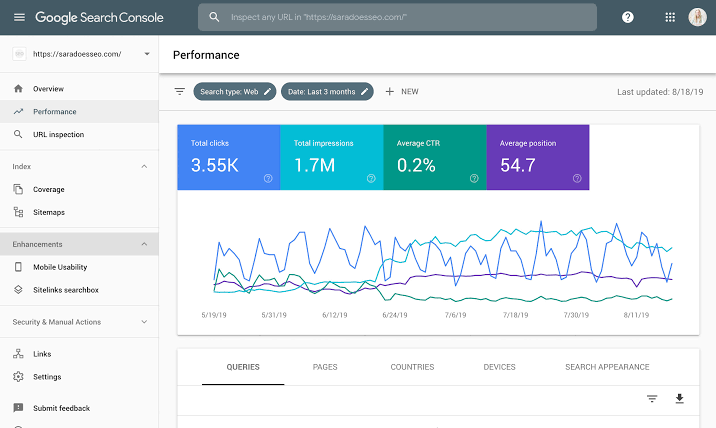
Open Google Search Console and navigate to Performance → Search results.
Review your average position, impressions, clicks, and the queries bringing people to your website.
If your pages receive impressions but have a poor average position, your priority may be to improve their relevance, usefulness, technical accessibility, and authority relative to competing pages.
What to do:
- Identify the search terms relevant to your services.
- Review the pages currently ranking for those terms.
- Make your page more useful and specific to the searcher’s needs.
- Strengthen internal links to important pages.
- Publish supporting content that answers related customer questions.
Don’t expect an overnight jump to the first page. SEO improvements can take time to appear in search results.
3. You’re Targeting the Wrong Keywords
One of the most common SEO mistakes is targeting keywords that don’t match what your potential customers actually search for.
Imagine you provide SEO services to Nigerian businesses, but your website focuses on broad phrases such as “online growth solutions” or “digital excellence.”
Those phrases may sound professional, but they don’t clearly describe the service someone is looking to hire.
Compare these examples:
- Broad: Digital growth solutions
- Specific: SEO services in Nigeria
- Broad: Better online visibility
- Specific: SEO agency in Lagos
- Broad: Business promotion
- Specific: Facebook Ads management in Nigeria
The more specific phrases communicate a clearer service and can attract people with stronger commercial intent, depending on the competition and search demand.
What to do:
Create a keyword map for your website. Assign a primary search topic to each important page.
For example:
| Website page | Primary keyword |
|---|---|
| Homepage | Digital marketing agency in Nigeria |
| Social media service | Social media management services |
| SEO service | SEO services in Nigeria |
| Ads service | Meta Ads management in Nigeria |
These are starting hypotheses, not guaranteed high-volume keywords. Check actual search queries and competition before committing to them.
4. Your SEO Titles Don’t Give People a Reason to Click
Getting impressions is only part of the job. You also need people to choose your result.
Your SEO title is often the most prominent part of your listing in Google Search. A vague or generic title can make your page less compelling than competing results.
For example:
Weak title:
Home | Digital Media Oga
More descriptive title:
SEO Services in Nigeria | Digital Media Oga
The second title makes the page topic clear and tells potential customers what they can expect.
You can make titles more compelling by being specific about the service, audience, or benefit. Avoid exaggerated promises, unnecessary repetition, and keyword stuffing.
What to do:
Review the titles of pages that already receive impressions in Google Search Console. Prioritize pages with relevant impressions and a low click-through rate, while considering their average ranking position.
Update titles to reflect the page accurately. Google may generate a different title link in search results, so your chosen title isn’t guaranteed to appear exactly as written.
5. Your Meta Descriptions Are Too Generic
Your meta description is the short summary you provide for a page. Google may use it in the search result snippet, although it can also generate a different snippet from the page content.
A weak description might say:
“We provide quality digital marketing services to help businesses grow.”
That tells a potential customer very little.
A more specific description might say:
“Need SEO services in Nigeria? Discover how Digital Media Oga helps businesses improve search visibility, attract relevant visitors and generate enquiries.”
The second example identifies the service, explains the value, and speaks to a potential customer’s needs.
What to do:
Write a unique description for every important page. Explain what the page offers, who it is for, and why it is worth visiting.
Keep it natural and accurate. There is no guaranteed character count that prevents truncation, and Google may choose its own snippet depending on the search.
6. Your Content Doesn’t Answer What People Are Searching For
Imagine someone searches Google for “How much does SEO cost in Nigeria?”
They click a result expecting a useful explanation, but the page only talks about how passionate an agency is about helping businesses grow.
The visitor is likely to leave and look elsewhere.
This is a search-intent problem.
Your content must address the reason behind the search, not simply contain the keyword.
If someone searches for a service, explain what you offer, how it works, who it helps, and how they can get started. If someone is researching a problem, give them practical information that helps them understand or solve it.
What to do:
Before writing or updating a page:
- Search your target keyword on Google.
- Review the types of pages that appear.
- Identify the questions those pages answer.
- Look for useful details or explanations missing from the available results.
- Create content that addresses the topic thoroughly and adds your own experience or insight.
Avoid publishing articles simply to increase your blog count. Useful, original content is more valuable than repetitive articles written around similar keywords.
7. Your Website Has Too Little Useful Content
A page with only a headline, a short paragraph, and a contact button may not give visitors enough information to understand your service.
For a service business, potential customers may want to know:
- What exactly do you do?
- Who is the service suitable for?
- What is included?
- How does your process work?
- What makes your approach different?
- What evidence supports your claims?
- How can someone get started?
You don’t need to write thousands of words to answer these questions. You need enough useful information to satisfy the visitor’s needs.
What to do:
Review your most important service pages and add relevant explanations, examples, process details, frequently asked questions, testimonials, and case studies where appropriate.
For example, your SEO services page could link to a practical article explaining why websites struggle to attract organic traffic. That article could then direct interested readers back to your SEO service.
This helps visitors discover relevant information while creating a clearer structure for search engines.
8. Your Website Is Slow or Difficult to Use on Mobile
A website can have good content but still frustrate visitors if it takes too long to load or is difficult to navigate on a phone.
This matters particularly when people visit from mobile devices or slower internet connections.
Common problems include:
- Oversized images
- Heavy videos that load immediately
- Too many unnecessary scripts
- Pop-ups that cover the content
- Tiny text and difficult navigation
- Contact buttons that are hard to find
What to do:
Use Google PageSpeed Insights to assess your homepage and important service pages on mobile and desktop.
Compress large images, use modern image formats where supported, remove unnecessary scripts, and make sure your content and contact buttons work well on smaller screens.
Also review Google’s Core Web Vitals, which measure aspects of loading performance, responsiveness, and visual stability.
Don’t focus on achieving a perfect speed score at the expense of usability. Prioritize changes that improve the real experience for your visitors.
9. Your Website Has Weak Internal Linking
Internal links connect one page on your website to another.
Without them, useful pages may be difficult for visitors and search engines to discover.
For example, a reader might find your article about website traffic but never discover that you offer SEO services because there is no relevant link between the two pages.
What to do:
Connect related pages naturally.
Your blog post about website traffic could link to your SEO services page using descriptive anchor text such as SEO services for businesses.
Your SEO services page could link to:
- Relevant SEO articles
- Case studies
- Your contact page
- Your discovery-call booking page
Use links where they genuinely help the reader. Avoid adding irrelevant links or repeating the same keyword unnaturally throughout every page.
10. Your Website Lacks Credibility and Original Evidence
People want to know whether they can trust the business behind a website.
If your pages contain only generic marketing statements, visitors have little reason to choose you over another agency.
Evidence can make your content more useful and persuasive.
Depending on your business, this might include:
- Real client testimonials
- Relevant case studies
- Examples of work completed
- Screenshots of campaign or SEO performance
- A clear explanation of your working process
- Accurate information about your team and experience
What to do:
Add evidence that supports the claims you make. Explain the problem a client faced, the work you completed, and the results you can genuinely demonstrate.
Always obtain permission before sharing confidential client information, and never invent statistics or testimonials.
For a service business, credibility matters beyond rankings. It can also help turn a website visit into a qualified enquiry.
11. You’re Not Measuring What Happens After the Click
This is where many businesses lose sight of the bigger picture.
You may be monitoring impressions, clicks, and rankings without knowing whether the traffic is generating enquiries.
But a visitor who arrives on your website and leaves without understanding your offer is not necessarily a business opportunity.
What to do:
Use Google Search Console to monitor organic impressions, clicks, click-through rate, and average position.
Use Google Analytics 4 or another suitable analytics tool to understand what visitors do after arriving on your website. Where possible, configure conversion events for actions such as submitting an enquiry form or completing a booking.
For phone calls and WhatsApp enquiries, use appropriate tracking where feasible and ask new leads how they found your business.
Your goal is to understand the complete journey:
Google Search → Website Visit → Enquiry → Discovery Call → Customer
This helps you distinguish between a website that simply attracts traffic and one that contributes to business growth.
What Should You Fix First?
You don’t need to tackle all 11 problems in one day. Start with the issues that are most likely to affect your current website.
Use this simple checklist:
- Check whether your important pages are indexed.
- Review your top search queries and landing pages in Google Search Console.
- Identify relevant queries with impressions but few clicks.
- Improve titles and descriptions where they do not accurately communicate the page’s value.
- Make sure each service page answers its audience’s main questions.
- Add relevant internal links between articles and service pages.
- Check mobile usability and page performance.
- Add real work examples, testimonials, and case studies.
- Set up tracking for enquiries and calls.
- Review the results after Google has had time to recrawl and reassess your pages.
Don’t change everything at once without recording your starting metrics. Keeping track of the changes you make will help you understand which improvements are actually helping.
How Digital Media Oga Can Help
If your website isn’t attracting the right visitors, the answer may be more than publishing another blog post.
You may need a clearer keyword strategy, stronger service pages, better technical SEO, more useful content, or a website experience that encourages visitors to take action.
At Digital Media Oga, we approach SEO as part of a wider business growth strategy. Our goal is to help businesses improve their search visibility, attract relevant visitors, and create clearer paths from website visits to enquiries.
We can help you identify opportunities, prioritize improvements, and build an SEO strategy around your business goals.
Ready to Find Out What’s Holding Your Website Back?
Stop guessing why your website isn’t getting the traffic or enquiries you expected.
Let’s review your website, identify opportunities for improvement, and work out the next practical steps.
Your website should do more than exist online. It should help the right people find your business and understand why they should choose you.